Business Compliance & Carbon Accounting
Carbon accounting NZ refers to the process of measuring, monitoring, and reporting greenhouse gas emissions produced by New Zealand businesses. Under the Zero Carbon Act, it ensures organisations quantify their environmental impact—categorised into Scopes 1, 2, and 3—to comply with mandatory climate disclosures and support the national goal of net-zero emissions by 2050.
What is Carbon Accounting in New Zealand?
Carbon accounting in New Zealand has transitioned from a niche corporate social responsibility (CSR) activity to a core business compliance requirement. At its heart, carbon accounting is the process of assigning a numerical value to the greenhouse gases (GHG) emitted by an organisation’s activities. These values are typically expressed in tonnes of carbon dioxide equivalent (tCO2e).
For New Zealand enterprises, this process is governed by international standards such as the Greenhouse Gas Protocol and local frameworks established by the External Reporting Board (XRB). As the nation pushes toward its 2050 net-zero target, businesses are increasingly required to provide transparent, verifiable data regarding their carbon intensity. This transparency allows investors, regulators, and consumers to assess the climate risk associated with a particular entity.

Mandatory Climate Disclosures: Who Must Comply?
New Zealand was the first country in the world to pass legislation making climate-related disclosures mandatory for certain financial sectors. This was achieved through the Financial Sector (Climate-related Disclosures and Other Matters) Amendment Act 2021. The mandate targets “Climate Reporting Entities” (CREs), which include large listed issuers, large banks, licensed insurers, and managers of registered investment schemes.
The Role of the External Reporting Board (XRB)
The XRB is responsible for issuing the New Zealand Climate Standards (NZCS). These standards are based on the recommendations of the Task Force on Climate-related Financial Disclosures (TCFD). Entities must report across four pillars: Governance, Strategy, Risk Management, and Metrics and Targets. For these organisations, carbon accounting NZ is no longer optional; it is a statutory obligation that requires rigorous data collection and external assurance.
While the initial wave of compliance affects approximately 200 large entities, the ripple effect is significant. These large entities are now requiring carbon data from their entire supply chains to fulfil their own reporting requirements, effectively pulling smaller businesses into the carbon accounting ecosystem.
How to Measure Your Carbon Footprint: Scope 1, 2, and 3
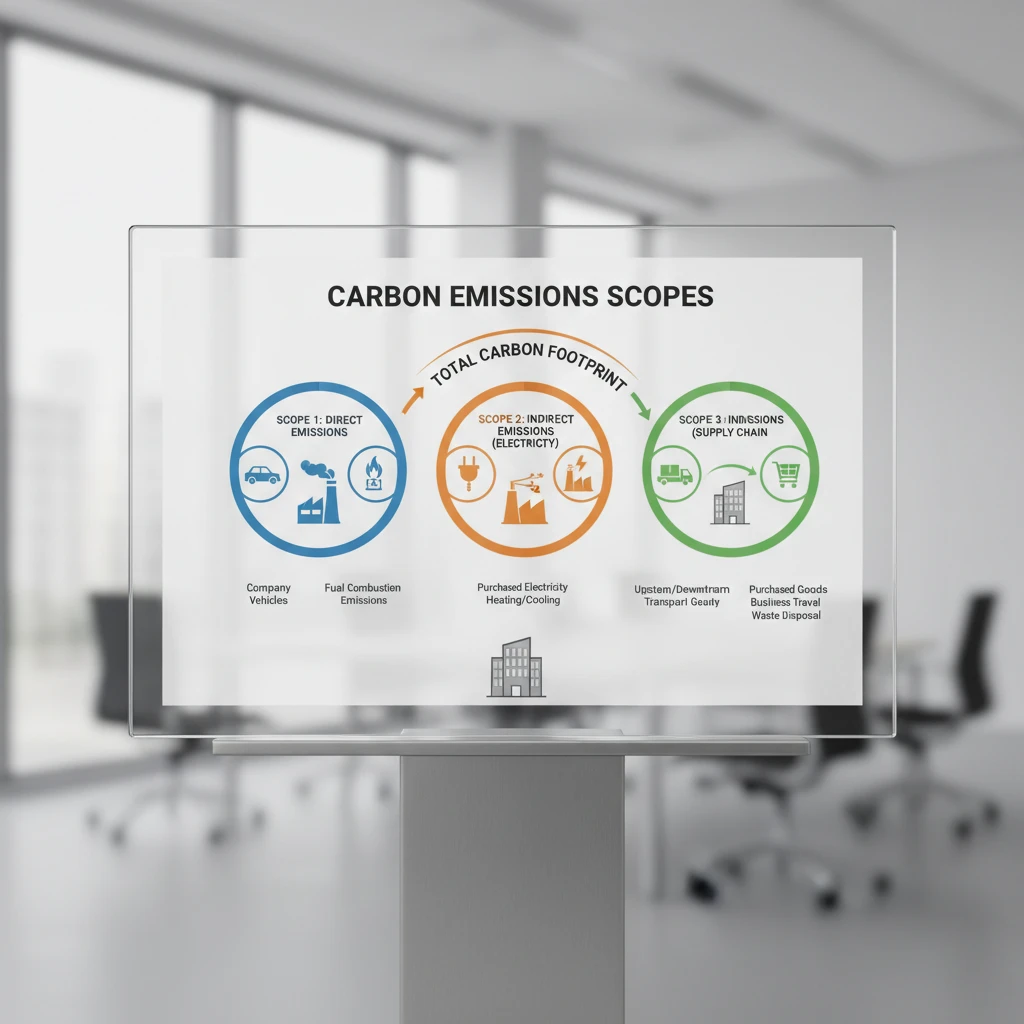
To accurately perform carbon accounting, a business must categorise its emissions into three distinct “scopes” as defined by the GHG Protocol. This classification helps prevent double-counting and provides a clear picture of where an organisation’s environmental impact lies.
- Scope 1: Direct Emissions. These are emissions from sources that are owned or controlled by the company. Examples include company vehicles (petrol/diesel), on-site gas boilers, and refrigerant leakages.
- Scope 2: Indirect Energy Emissions. These result from the generation of purchased electricity, heat, or steam consumed by the company. In NZ, the carbon intensity of Scope 2 emissions depends heavily on the national grid’s renewable energy mix at any given time.
- Scope 3: Indirect Value Chain Emissions. These are often the largest portion of a business’s footprint. They include emissions from business travel, waste disposal, purchased goods and services, and the use of sold products.
Understanding Scope 3: The Supply Chain Challenge
For many New Zealand businesses, Scope 3 emissions represent upwards of 80% of their total carbon footprint. Measuring these requires collaboration with suppliers and a deep dive into procurement data. Under the new NZ Climate Standards, reporting on Scope 3 is becoming increasingly critical for a complete and honest disclosure of climate-related risks.
Sustainability Reporting for NZ SMEs: Why Start Now?
Small and Medium Enterprises (SMEs) might assume that carbon accounting NZ is only for the “big players.” However, there are several compelling commercial reasons for SMEs to adopt carbon reporting early. Firstly, as mentioned, larger corporate clients and government agencies are now including carbon performance in their procurement criteria. If you cannot provide a carbon footprint report, you may lose out on significant contracts.
Secondly, carbon accounting often reveals operational inefficiencies. A high carbon footprint usually correlates with high energy use or waste, both of which are costs. By measuring emissions, SMEs can identify areas for cost reduction, such as transitioning to electric vehicle fleets or optimising logistics. Finally, consumers in the New Zealand market are increasingly eco-conscious, often preferring brands that can prove their commitment to sustainability with hard data rather than vague “greenwashing” claims.

Navigating the Zero Carbon Act and Climate Policy
The Climate Change Response (Zero Carbon) Amendment Act 2019 provides the framework for New Zealand’s climate policies. It established the Climate Change Commission, which provides independent advice to the government on emissions budgets and adaptation measures. For businesses, the Act signifies a long-term shift in the regulatory environment.
The Act’s primary goal is to limit global warming to 1.5 degrees Celsius. To achieve this, NZ has committed to reducing all greenhouse gases (except biogenic methane) to net zero by 2050. This policy direction means that carbon prices via the Emissions Trading Scheme (ETS) are likely to rise over time, making carbon-intensive operations increasingly expensive. Carbon accounting allows businesses to forecast these costs and pivot their strategies accordingly.
Choosing Carbon Accounting Software and Verification
The complexity of tracking emissions across multiple sites and supply chains has led to a surge in carbon accounting software. These platforms automate data collection by integrating with accounting software like Xero or MYOB, converting spend data into carbon equivalents using industry-standard emission factors.
However, measurement is only the first step. To achieve high-level compliance or to use “Carbon Neutral” branding, businesses often require third-party verification. In New Zealand, organisations like Toitū Envirocare provide internationally recognised certification (such as Toitū net carbonzero). Verification ensures that your data is accurate, your boundaries are correctly set, and your reduction plans are credible.

Best Practices for Business Compliance
To succeed in carbon accounting NZ, businesses should follow a structured approach. Start by defining the organisational boundary—deciding which parts of the company are included in the report. Next, establish a “base year” against which future performance will be measured. It is crucial to use high-quality data; where actual usage data (like kilowatt-hours) is unavailable, spend-based estimates can be used, but they are less accurate.
Transparency is also key. When reporting, be clear about what has been included and, more importantly, what has been excluded. Acknowledge any data gaps and outline a plan to improve data quality in the next reporting cycle. This honesty builds trust with stakeholders and regulators alike.
Finally, carbon accounting should not be a static exercise. The data gathered must inform a robust Emissions Reduction Plan (ERP). Setting Science-Based Targets (SBTi) ensures that your reduction goals are in line with what is required to meet the Paris Agreement targets, providing a clear roadmap for your business’s transition to a low-carbon economy.