Climate Risk Disclosure NZ
Climate risk disclosure in New Zealand is a mandatory reporting regime requiring large financial institutions and listed companies to publicly disclose climate-related risks and opportunities. Governed by the External Reporting Board (XRB) standards, this framework ensures transparency regarding how entities manage physical and transition climate impacts under the Financial Sector (Climate-related Disclosures and Other Matters) Amendment Act 2021.
New Zealand has positioned itself as a world leader in climate action by becoming the first country to introduce a law requiring the financial sector to report on climate-related risks. For businesses operating within the Aotearoa New Zealand economy, understanding these obligations is no longer optional—it is a critical component of corporate governance and strategic planning.
The regime moves beyond simple carbon footprinting. It demands a rigorous analysis of how climate change impacts an organization’s business model, strategy, and financial stability over the short, medium, and long term. Failure to comply not only risks regulatory penalties but also threatens access to capital as investors increasingly screen for climate resilience.
Who Must Report Under the XRB Standards?
The Financial Sector (Climate-related Disclosures and Other Matters) Amendment Act 2021 designates specific organizations as “Climate Reporting Entities” (CREs). These entities are legally required to prepare and file annual climate statements. Understanding if your organization falls under this definition is the first step in compliance.

Which entities are classified as Climate Reporting Entities (CREs)?
The regime targets entities with a significant impact on the New Zealand capital markets. Currently, approximately 200 entities meet the criteria, which include:
- Large Listed Issuers: Companies listed on the NZX with a market capitalization exceeding NZ$60 million. This captures the majority of New Zealand’s major public corporations.
- Registered Banks: Banks, building societies, and credit unions with total assets exceeding NZ$1 billion. This ensures the banking sector is transparent about its exposure to climate risks in its lending portfolios.
- Licensed Insurers: Insurers with total assets greater than NZ$1 billion or premium income exceeding NZ$250 million. Insurers are on the front lines of physical climate risk, making their disclosures vital for market stability.
- Managers of Registered Investment Schemes: Investment managers with more than NZ$1 billion in total assets under management. This pushes climate accountability down the investment chain to the underlying assets.
Crown Financial Institutions (CFIs) are also required to report, although via letters of expectation rather than the Act itself, aligning the public sector with private market obligations.
Understanding the Aotearoa New Zealand Climate Standards
The External Reporting Board (XRB) has issued three distinct standards that form the backbone of the disclosure regime. These standards are heavily influenced by the Task Force on Climate-related Financial Disclosures (TCFD) recommendations but are tailored for the New Zealand context.
What are the three XRB Climate Standards?
To achieve compliance, CREs must adhere to the following:
- NZ CS 1: Climate-related Disclosures: This is the primary standard outlining the disclosure requirements across four thematic areas: Governance, Strategy, Risk Management, and Metrics and Targets. It dictates what must be disclosed.
- NZ CS 2: Adoption Provisions: This standard provides adoption relief for entities reporting for the first time. It acknowledges the complexity of the requirements and allows for a phased approach to certain disclosures, such as Scope 3 emissions or financial impact analysis, during the initial reporting periods.
- NZ CS 3: General Requirements: This covers the principles of fair presentation, materiality, and the general framework for preparing the climate statements. It ensures that the information provided is relevant, accurate, and verifiable.
The core of NZ CS 1 requires entities to disclose not just their carbon footprint, but the resilience of their business strategy against various climate scenarios. This shifts the focus from purely environmental reporting to financial and strategic reporting.
Identifying Physical vs. Transition Risks
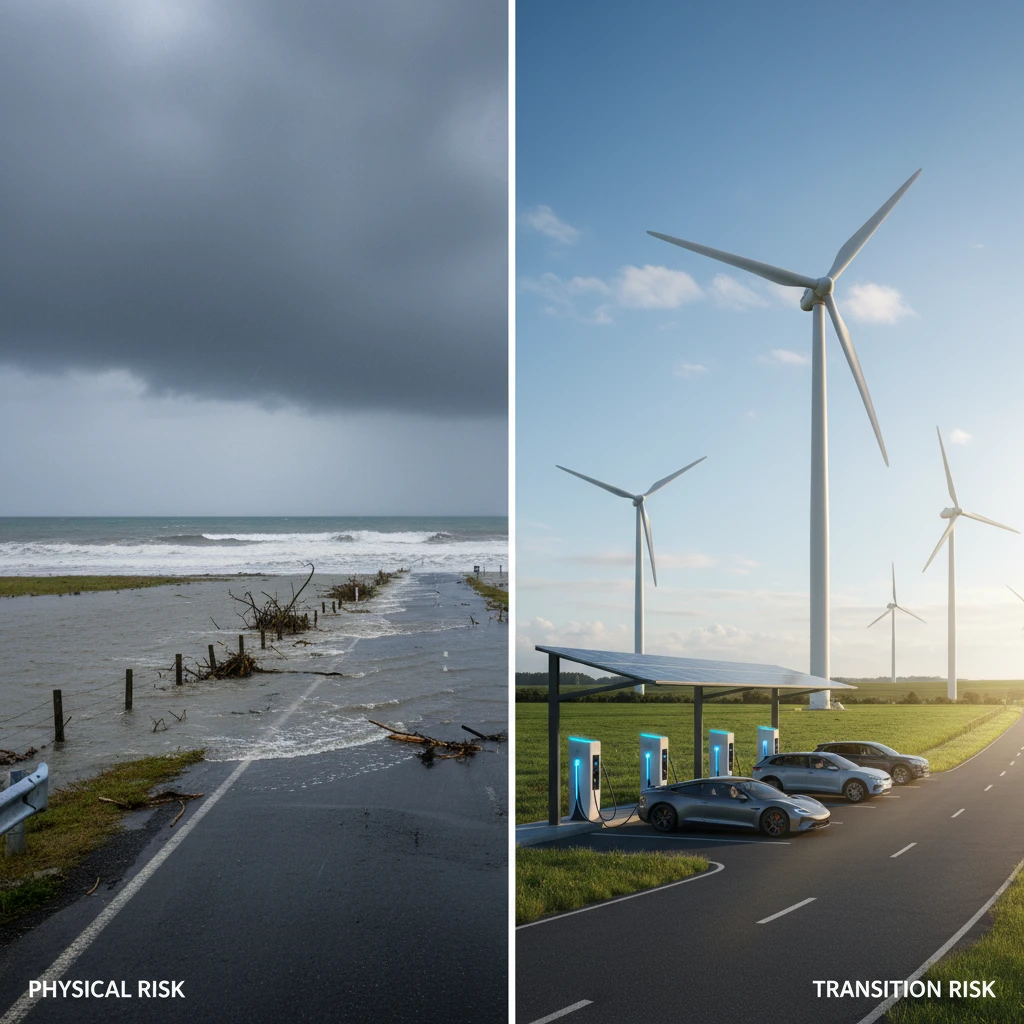
A robust climate risk assessment requires distinguishing between physical risks (direct damage from climate patterns) and transition risks (financial impacts from moving to a low-carbon economy). For New Zealand businesses, both categories present unique challenges.
What are Physical Risks in the NZ Context?
Physical risks are categorized into acute and chronic risks:
- Acute Risks: Event-driven hazards such as cyclones, floods, and wildfires. For example, the impact of Cyclone Gabrielle on forestry and infrastructure highlighted the acute vulnerability of supply chains in the North Island. Insurers must disclose exposure to properties in flood-prone zones.
- Chronic Risks: Longer-term shifts in climate patterns, such as sustained higher temperatures, sea-level rise, and changing rainfall patterns. For the agricultural sector, this might mean changing crop viability in regions like Marlborough or Hawke’s Bay due to drought or heat stress.
What are Transition Risks?
Transition risks arise from the process of adjustment towards a low-carbon economy. These can often be more immediate and financially damaging than physical risks for certain sectors:
- Policy and Legal Risks: Costs associated with the NZ Emissions Trading Scheme (ETS), carbon taxes, or litigation for failing to mitigate climate impacts.
- Technology Risks: The risk of assets becoming “stranded” because they are incompatible with new low-carbon technologies (e.g., coal boilers or internal combustion engine fleets).
- Market Risks: Shifts in supply and demand. For instance, global consumers may reject NZ exports if they are perceived as having high embodied carbon (food miles).
- Reputation Risks: Loss of brand value due to changing customer perceptions or accusations of greenwashing.
Scenario Analysis for NZ Businesses
Scenario analysis is arguably the most challenging aspect of the XRB standards. It requires entities to construct hypothetical futures to test the resilience of their strategies. It is not about predicting the future, but about preparing for multiple plausible futures.

How should CREs conduct scenario analysis?
Under NZ CS 1, entities are required to analyze at least three climate-related scenarios, including one 1.5°C scenario and one greater than 3°C scenario.
- 1.5°C Scenario (Orderly Transition): Assumes rapid and stringent global climate action. Transition risks are high (high carbon prices, strict regulations), but physical risks are managed. Businesses must demonstrate how they survive high compliance costs and rapid technological shifts.
- >3°C Scenario (Hot House World): Assumes global failure to curb emissions. Transition risks are low (business as usual), but physical risks are extreme. Businesses must demonstrate resilience against severe weather events, supply chain collapses, and infrastructure failure.
- Disorderly Transition: A middle-ground scenario where action is delayed and then sudden. This combines high physical risks initially with shock-therapy regulations later, creating a volatile environment for planning.
For a New Zealand property portfolio, a >3°C scenario analysis might reveal that 20% of assets become uninsurable due to sea-level rise by 2050. A 1.5°C analysis might show that the remaining 80% require expensive retrofitting to meet energy efficiency standards. Both scenarios impact valuation and capital expenditure planning.
Commercial Implications and Access to Capital
While compliance is the immediate driver, the commercial intent behind the legislation is to redirect capital flows toward sustainable activities. The disclosures act as a signal to the market.
How does disclosure affect borrowing and investment?
Banks and investors use these disclosures to price risk. If a CRE’s climate statement reveals a lack of strategy for dealing with carbon pricing or physical hazards, lenders may:
- Increase interest rates on debt facilities to cover the higher perceived risk.
- Refuse to refinance assets in vulnerable locations.
- Divest entirely from companies that do not have a credible transition plan.
Conversely, robust disclosure can be a competitive advantage. Companies that clearly articulate their transition plan and demonstrate resilience are viewed as “future-proof,” attracting “green capital” often at lower costs through instruments like sustainability-linked loans.
Consultants for Climate Risk Assessment
Given the complexity of climate science and financial modeling, many CREs engage external consultants. However, the XRB emphasizes that governance cannot be outsourced—directors must understand the risks.

What should you look for in a climate risk consultant?
When selecting a partner to assist with climate risk disclosure in NZ, consider the following:
- Multi-disciplinary Expertise: The team should include climate scientists (to model physical risks), economists (to model transition impacts), and accountants (to integrate findings into financial statements).
- Local Knowledge: Global models often lack the granularity required for New Zealand’s specific geography. Ensure they utilize NIWA climate data and understand the specific nuances of the NZ ETS.
- Software Capabilities: Manual spreadsheets are insufficient for complex scenario analysis. Look for consultants who leverage carbon accounting software and climate risk platforms that can update scenarios as science evolves.
- Assurance Readiness: Eventually, GHG emissions disclosures will require independent assurance. Your consultants should prepare your data trails to survive an audit.
Leading firms often combine legal advice on liability with technical advice on emissions measurement. The goal is not just to produce a compliant PDF document but to integrate climate thinking into the organization’s DNA.
Frequently Asked Questions
When did mandatory climate reporting start in NZ?
Mandatory reporting took effect for accounting periods starting on or after 1 January 2023. This means the first climate statements were generally published in early 2024 for entities with standard financial years.
What are the penalties for non-compliance with XRB standards?
The Financial Markets Authority (FMA) is responsible for enforcement. Penalties for failing to lodge statements or keeping proper records can be significant, including fines up to $50,000 for individuals and $2.5 million for entities, alongside potential reputational damage.
Do private companies need to report climate risks?
Currently, large private companies that do not meet the “large listed issuer” or financial institution criteria are not mandated to report under the Act. However, they face indirect pressure as banks and supply chain partners (who are CREs) request data to fulfill their own Scope 3 reporting obligations.
What is the difference between Scope 1, 2, and 3 emissions?
Scope 1 covers direct emissions from owned sources (e.g., company cars). Scope 2 covers indirect emissions from purchased energy (e.g., electricity). Scope 3 covers all other indirect emissions in the value chain (e.g., business travel, waste, and supply chain manufacturing), which are often the largest and hardest to measure.
Is assurance mandatory for climate statements?
Assurance is being phased in. Initially, mandatory assurance is required only for the Greenhouse Gas (GHG) emissions disclosures within the climate statement. This requirement kicks in for accounting periods ending on or after 27 October 2024.
How does NZ’s regime compare to international standards?
New Zealand’s regime is closely aligned with the TCFD and is compatible with the emerging IFRS S1 and S2 global sustainability standards. This ensures that NZ businesses remain attractive to international investors looking for standardized climate data.
About The Author
