EV Subsidies and Infrastructure NZ
As of 31 December 2023, the New Zealand government officially ended the Clean Car Discount scheme, meaning direct financial subsidies and rebates for purchasing electric and plug-in hybrid vehicles are no longer available. Current policy focuses on expanding national charging infrastructure and managing the transition to Road User Charges (RUC) for zero-emission vehicles.
The landscape of electric vehicle (EV) ownership in New Zealand has undergone a significant transformation in the last 12 months. With the repeal of the Clean Car Discount and the introduction of Road User Charges for EVs, the financial equation for Kiwi drivers has shifted. However, the commitment to the Zero Carbon Act and the rapid expansion of the public charging network continues to drive adoption. This comprehensive guide analyzes the current state of EV incentives, the economics of ownership without rebates, and the roadmap for infrastructure development.
The Current Status of EV Subsidies in NZ
The era of the “Clean Car Discount”—often referred to as the “Tesla rebate”—concluded at the end of 2023. Understanding the current policy framework is essential for prospective buyers navigating the market in 2024 and beyond.
The End of the Clean Car Discount
Introduced to accelerate the uptake of low-emission vehicles, the Clean Car Discount provided rebates of up to $7,015 for new electric vehicles. The new coalition government repealed this legislation, citing the need to return the market to a self-sustaining model. Consequently, for any vehicle registered after 31 December 2023, no government rebate is applicable, regardless of when the deposit was placed.
The Clean Car Standard vs. The Discount
It is crucial to distinguish between the Clean Car Discount (repealed) and the Clean Car Standard (active). While the consumer-facing rebate is gone, the Clean Car Standard remains in effect for vehicle importers. This policy regulates the average emissions of vehicles brought into the country.
Importers bringing in high-emitting vehicles must pay fees, while those importing low-emission vehicles earn credits. This backend mechanism ensures that the supply of EVs into New Zealand remains consistent and that manufacturers are incentivized to send their cleanest technology to our shores, indirectly influencing the sticker price and availability of EVs.
Understanding Road User Charges (RUC) for EVs
Perhaps the most significant change to the financial landscape of EV ownership in New Zealand is the inclusion of electric vehicles in the Road User Charges (RUC) system as of 1 April 2024. Previously, EVs were exempt from RUCs to encourage uptake.
Why RUCs were Introduced for EVs
Petrol taxes in New Zealand generally fund the National Land Transport Fund (NLTF), which pays for road maintenance and new infrastructure. Because EV owners do not buy petrol, they were effectively using the roads without contributing to their upkeep during the exemption period. As the fleet size grew (surpassing 100,000 units), the government moved to ensure all road users contribute fairly to transport funding.
Current RUC Rates
As of the latest update, the RUC rates for light electric vehicles are:
- Battery Electric Vehicles (BEVs): $76 per 1,000km.
- Plug-in Hybrid Electric Vehicles (PHEVs): $38 per 1,000km.
PHEVs attract a lower rate because they also consume petrol, meaning owners pay fuel excise duty at the pump. This dual-rate system attempts to prevent double taxation, though it remains a point of contention for PHEV owners who drive predominantly on electric power.
Public Charging Network Expansion
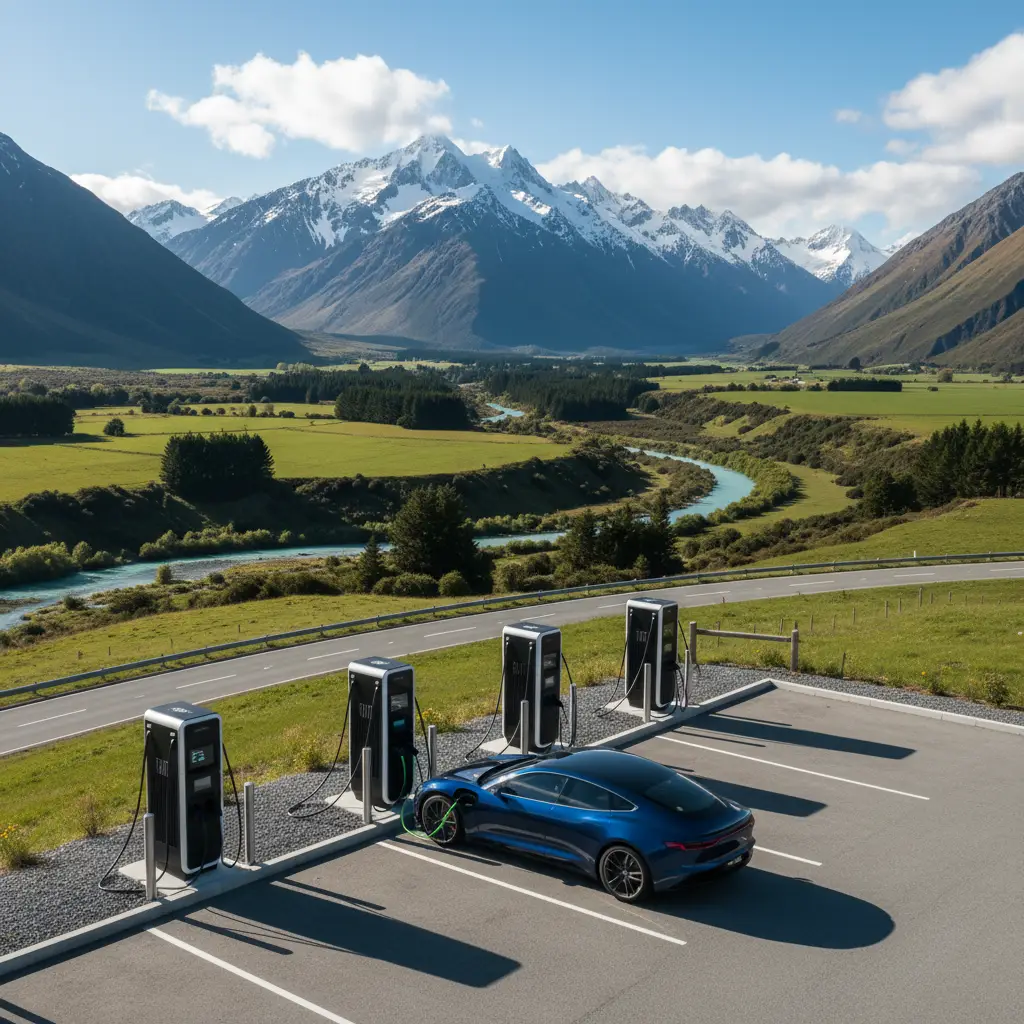
While direct subsidies have vanished, government investment has pivoted aggressively toward infrastructure. The “Charging Our Future” strategy aims to eliminate range anxiety and ensure that EV charging is as convenient as refueling a petrol car.
Government Co-Funding and EECA
The Energy Efficiency and Conservation Authority (EECA) continues to administer the Low Emission Transport Fund (LETF). This fund provides co-funding for public charging infrastructure. The strategic goal is to have high-speed charging hubs every 75–100km along main state highways.
The Rise of High-Speed Hyper-Chargers
The network is not just growing in size but in speed. Early chargers were typically 50kW units. The new rollout focuses on:
- 300kW Hyper-Chargers: Capable of adding 400km of range in 15 minutes for compatible vehicles.
- Charging Hubs: Locations with multiple bays (4-10 chargers) to reduce queuing times, similar to traditional petrol station forecourts.
Major players like ChargeNet, Z Energy, and BP are competing to build out this infrastructure, resulting in a rapidly densifying network that makes road trips from Cape Reinga to Bluff entirely feasible.
Home Charging and Grid Integration
Despite the focus on public infrastructure, approximately 80% of EV charging in New Zealand takes place at home. This aligns perfectly with New Zealand’s electricity grid profile, which is highly renewable (typically 80-85% renewable generation).

Smart Charging and Off-Peak Rates
Electricity retailers are increasingly offering specialized “EV Plans.” These plans offer significantly cheaper rates (often half price or even free hours) during off-peak times (usually 9 PM to 7 AM). By utilizing smart chargers that can be scheduled, EV owners can refuel their vehicles for the equivalent of 30-40 cents per liter of petrol.
V2G: Vehicle to Grid Technology
New Zealand is currently trialing Vehicle-to-Grid (V2G) technology. This allows EVs to act as mobile batteries, storing energy when it is cheap and feeding it back into the home or grid during peak demand. While not yet mainstream, this technology represents the next frontier in integrating transport with the national energy strategy.
Benefits of Switching to Electric in a Post-Subsidy Market
Is it still worth buying an electric vehicle in New Zealand without the $7,015 rebate? The answer relies on a calculation of Total Cost of Ownership (TCO) rather than just the upfront purchase price.
Running Cost Comparison
Even with Road User Charges added, the cost per kilometer for an EV remains lower than an internal combustion engine (ICE) vehicle.
Example Calculation:
- Petrol Car (8L/100km @ $2.80/L): $22.40 per 100km.
- EV (18kWh/100km @ $0.30/kWh + $7.60 RUC): $13.00 per 100km.
If charging strictly on off-peak night rates (e.g., $0.15/kWh), the cost drops further to roughly $10.30 per 100km, representing less than half the running cost of a petrol equivalent.
Maintenance Savings
EVs have roughly 20 moving parts in their drivetrain compared to 2,000 in an internal combustion engine. This results in significantly lower maintenance costs over the vehicle’s life. There are no oil changes, spark plugs, cam belts, or exhaust systems to replace. Regenerative braking also significantly extends the life of brake pads and discs.
Environmental Contribution
New Zealand’s electricity grid is one of the cleanest in the world. Charging an EV in NZ results in significantly lower lifecycle emissions compared to many other countries that rely on coal or gas for power generation. For businesses and individuals conscious of their carbon footprint, EVs remain the most effective tool for decarbonizing personal transport.
Frequently Asked Questions
Are there any EV subsidies left in NZ for 2024?
No, the Clean Car Discount was fully repealed on 31 December 2023. There are currently no direct government rebates for purchasing electric or hybrid vehicles.
How much do I pay in Road User Charges (RUC) for an EV?
Owners of light electric vehicles (BEVs) pay $76 per 1,000km. Owners of Plug-in Hybrid Electric Vehicles (PHEVs) pay a reduced rate of $38 per 1,000km. You must purchase RUC licenses in blocks (e.g., 1,000km or 10,000km) from the NZTA/Waka Kotahi.
Is it cheaper to run an EV now that RUCs are introduced?
Yes, generally speaking. While the gap has narrowed, the combination of low off-peak electricity rates and high petrol prices means EVs are still cheaper to run per kilometer than comparable petrol vehicles, usually saving drivers around 40-50% in fuel costs.
Do hybrids (non-plugin) pay Road User Charges?
No. Standard hybrids (like the Toyota Prius non-plugin version) that cannot be plugged into a wall socket do not pay RUCs. They contribute to the National Land Transport Fund through the petrol excise tax they pay at the pump.
Are there enough chargers for a road trip in NZ?
Yes. New Zealand has a comprehensive network of DC fast chargers covering almost the entire state highway network. With chargers roughly every 75km on major routes, road trips are feasible, though planning during peak holiday periods is recommended.
What happens to the EV battery at the end of its life?
New Zealand is developing a product stewardship scheme for large batteries. Currently, degraded EV batteries are often repurposed for stationary storage (like solar storage for homes) before being ultimately recycled to recover valuable materials like lithium and cobalt.
About The Author
