Native vs Exotic Forestry for NZUs
Native vs exotic forestry in New Zealand differs primarily in carbon sequestration rates and regulatory treatment under the ETS. Exotic species (Radiata Pine) offer rapid carbon uptake and higher short-term NZU returns, making them financially attractive for immediate cash flow. Conversely, native forests provide superior biodiversity, lower long-term ecological risk, and stable, perpetual carbon accumulation, though with higher establishment costs and slower initial growth rates.
The decision between planting native species or exotic timber for carbon farming is the single most critical choice facing New Zealand landowners today. With the price of New Zealand Units (NZUs) fluctuating and government regulations regarding the Emissions Trading Scheme (ETS) tightening, understanding the nuanced economics of native vs exotic forestry NZ is essential for compliance and profitability.
Carbon Sequestration Rates: Pine vs. Native
When analyzing the investment potential of forestry, the rate at which trees absorb carbon dioxide (CO2) is the primary driver of revenue. Under the current Ministry for Primary Industries (MPI) look-up tables, there is a stark contrast between exotic monocultures and indigenous regeneration.
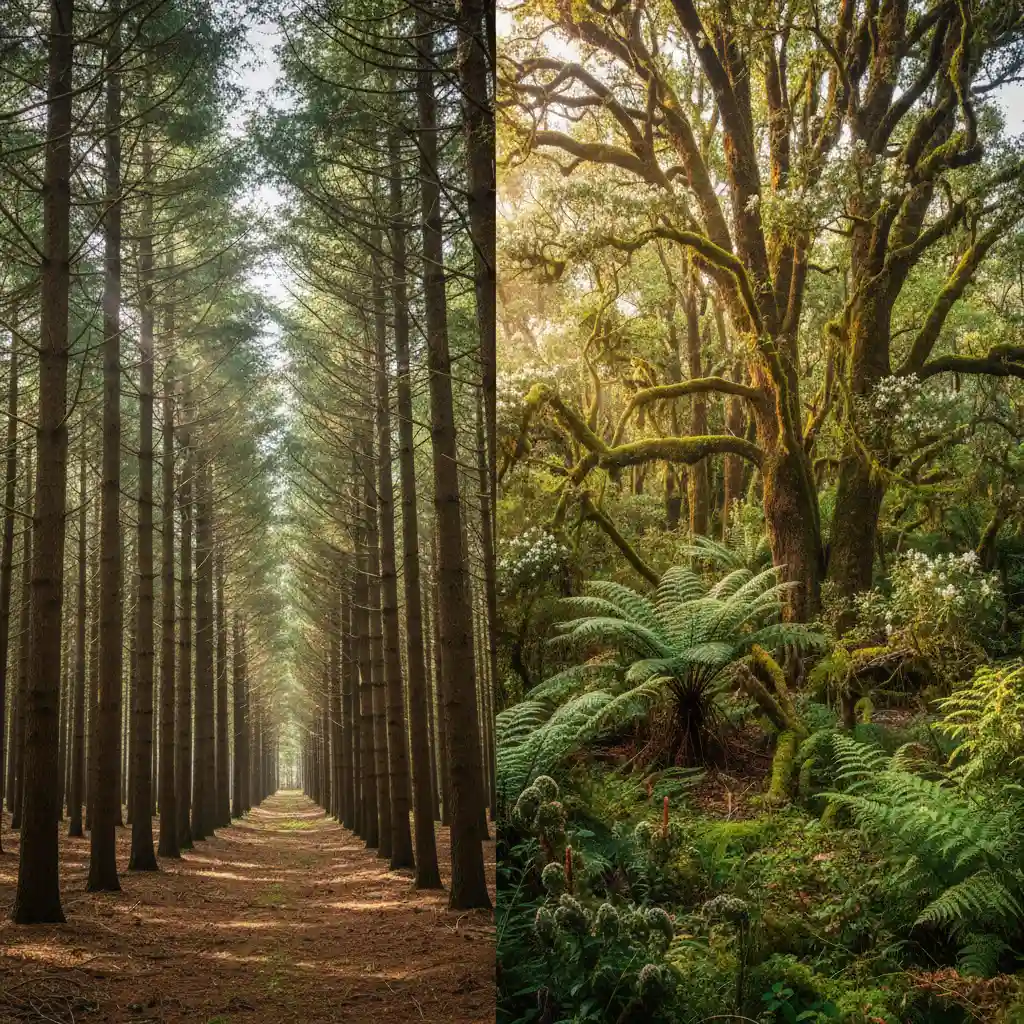
The Exotic Advantage: Radiata Pine
Pinus radiata is the engine room of the New Zealand forestry sector. Biologically, it is an aggressive grower that reaches canopy closure quickly. In terms of the ETS, this translates to a rapid accumulation of NZUs.
- Peak Sequestration: Pine forests typically reach peak carbon sequestration between years 10 and 20.
- Volume: Depending on the region (e.g., Gisborne/Hawke’s Bay vs. Canterbury), a well-managed pine plantation can sequester between 25 to 35 tonnes of CO2 per hectare per year during peak growth.
- Financial Implication: For an investor seeking a return within an investment horizon of 15-20 years, exotics provide a significantly faster payback period.
The Native Trajectory: Slow and Steady
Native forests—comprising species like Manuka, Kanuka, Totara, and Beech—follow a different biological curve. They are generally slower to establish but can continue sequestering carbon for centuries.
- Initial Rates: In the first decade, native regeneration may only sequester 3 to 6 tonnes of CO2 per hectare per year.
- Long-term Growth: As hardwood canopy species (like Rimu and Totara) emerge through the nursery crop (Manuka), sequestration rates stabilize and continue for significantly longer than the rotation age of pine.
- Carbon Density: While slower, the wood density of native hardwoods is higher, meaning the carbon stored per cubic meter of biomass is substantial once the forest is mature.
ETS Categories: Permanent vs. Averaging Accounting
The New Zealand Emissions Trading Scheme (NZ ETS) is not a “one size fits all” system. The classification of your forest dictates how many NZUs you earn and what your liabilities are.
Production Forestry (Averaging Accounting)
Most exotic forests intended for timber harvest fall under Averaging Accounting. Under this model, participants earn credits up to the long-term average carbon storage of the forest over multiple rotations. This removes the liability of surrendering credits upon harvest (provided the forest is replanted), but it caps the total number of credits you can earn—usually around age 16-17 for Radiata Pine.
Permanent Forestry Category
This category is designed for forests that will not be clear-felled for at least 50 years. This is where the native vs exotic forestry NZ debate becomes heated.
Exotics in Permanent Category: Historically, investors planted pine with no intention to harvest (
About The Author
