On-Farm Sequestration Rules
On-farm sequestration in New Zealand refers to the removal of carbon dioxide from the atmosphere by vegetation on agricultural land, such as indigenous forests, woodlots, and riparian plantings. Under the Zero Carbon Act, these sinks are essential for offsetting agricultural emissions, helping farmers manage their net carbon footprint and potential financial liabilities within the national emissions framework.
Recognized Carbon Sinks in New Zealand
In the context of the New Zealand Zero Carbon Act and the broader climate policy landscape, not all vegetation is created equal. The recognition of carbon sinks is a technical process governed by the Ministry for Primary Industries (MPI) and the Ministry for the Environment (MfE). For a farmer to claim sequestration, the vegetation must meet specific criteria regarding its age, height, and potential to reach forest status.
Indigenous Forest Regeneration
Indigenous or native forests are a cornerstone of New Zealand’s biodiversity and sequestration strategy. These include regenerating scrublands (such as Mānuka and Kānuka) and established podocarp forests. For these to be recognized as sinks, they must generally be on land that was not forested prior to 1990. The sequestration rate for native species is typically slower than exotic species like Radiata Pine, but they offer higher biodiversity value and permanent carbon storage.

Exotic Forest Plantations
Exotic species, primarily Pinus radiata, are the most efficient carbon sequesterers in the short term. These are often managed as production forests where trees are harvested, or as permanent carbon sinks. Under the current rules, exotic forests must meet the ‘forest land’ definition: at least one hectare in size, with tree crown cover of more than 30% in each hectare, and reaching a height of at least five meters at maturity.
Riparian Planting and Woodlots: Practical Sequestration
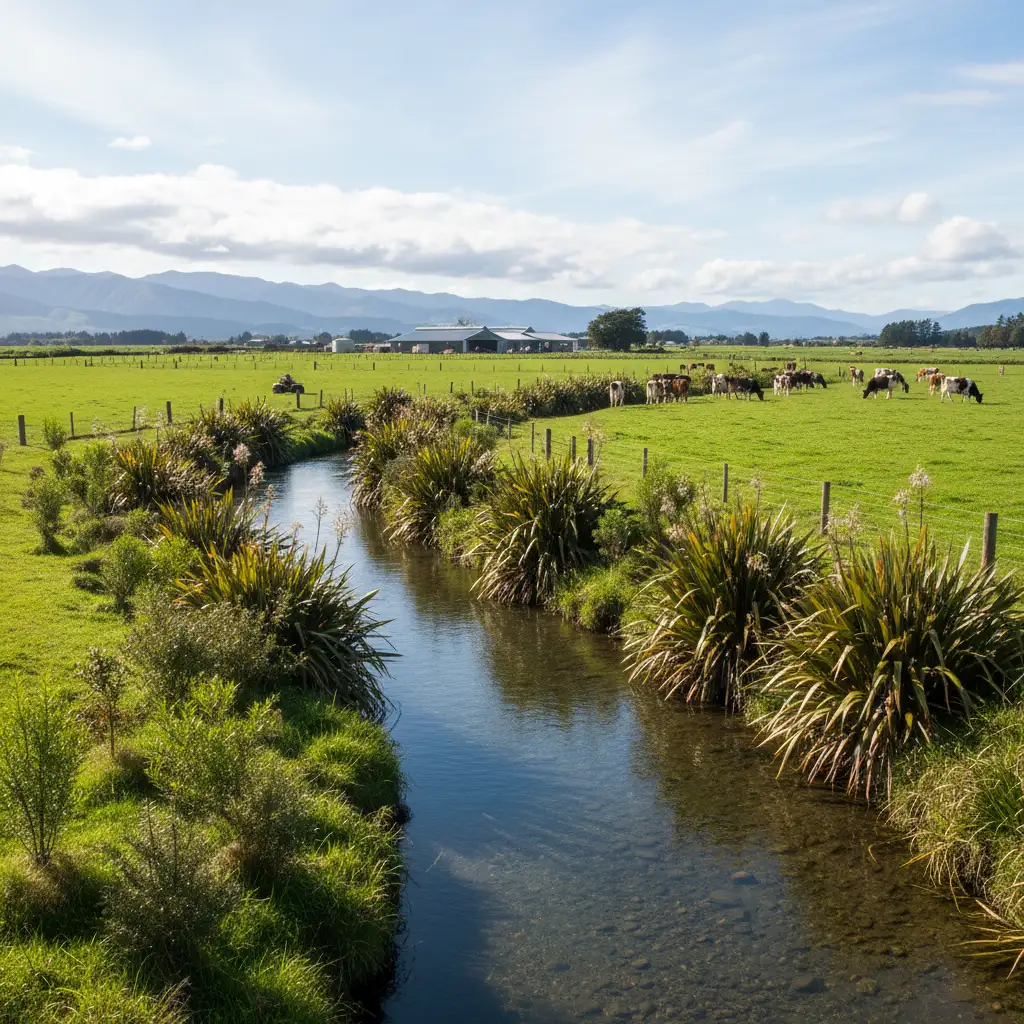
For many New Zealand farmers, large-scale afforestation is not feasible due to the need for productive pasture. This is where riparian planting and small woodlots become critical. These smaller-scale interventions allow for carbon sequestration to be integrated into existing farming systems without displacing primary production.
The Role of Riparian Strips
Riparian planting involves establishing vegetation along the banks of waterways. While historically used for water quality improvement and erosion control, these strips are now being evaluated for their carbon sequestration potential. However, a significant challenge in the current policy is the “forest land” definition. Many riparian strips are narrower than the 30-meter width required by the Emissions Trading Scheme (ETS). Advocacy continues for the recognition of these sub-hectare or narrow-strip plantings in future farm-level pricing mechanisms.
Woodlots and Shelterbelts
Small woodlots and shelterbelts are common features on NZ farms. When these areas exceed one hectare and meet the width requirements, they can be registered for carbon credits. Woodlots provide a dual benefit: they act as a carbon sink while also providing shade and shelter for livestock, which can improve animal welfare and productivity. Strategic placement of woodlots on marginal land—areas that are difficult to farm or prone to erosion—is often the most economically sensible approach for farmers.
Integration with the Emissions Trading Scheme (ETS)
The New Zealand Emissions Trading Scheme (ETS) is the primary tool for meeting climate targets. For farmers, understanding how on-farm sequestration integrates with the ETS is vital for financial planning. Currently, the ETS recognizes “Post-1989 forest land,” which refers to land that was not forest on December 31, 1989.
Averaging Accounting vs. Permanent Forests
Recent changes to the ETS introduced ‘averaging accounting’ for production forests. This system allows owners to earn credits up to the average carbon stock the forest will hold over several harvest cycles. This simplifies the process and removes the liability of paying back credits when the trees are harvested, provided the land is replanted. Conversely, ‘permanent’ forest categories are for land that will not be harvested for at least 50 years, allowing for the continuous accrual of credits as the forest grows.

The Concept of Additionality
A key principle in carbon sequestration rules is ‘additionality.’ This means that the carbon storage must be a result of a deliberate action that would not have occurred otherwise. For example, simply leaving an existing, old-growth forest alone may not qualify for new credits under certain frameworks because the carbon is already sequestered. The rules focus on new growth or active management that increases the carbon stock over time.
He Waka Eke Noa and the Future of Farm Pricing
He Waka Eke Noa was the primary partnership between the government, the primary sector, and iwi to develop a system for pricing agricultural emissions outside the ETS. While the political landscape regarding specific pricing mechanisms is fluid, the core objective remains: to reward farmers for the sequestration happening on their land that might not fit the strict ETS forest definitions.
Recognizing Non-ETS Sequestration
One of the biggest wins for the farming community during policy negotiations was the push to recognize ‘non-ETS’ sequestration. This includes scattered trees, shelterbelts, and smaller blocks of native vegetation. The goal is to ensure that a farmer’s total net emissions profile is accurate, accounting for all the carbon being absorbed by the farm’s natural assets, not just the large forests.
Calculating and Reporting Sequestration
Accurate measurement is the backbone of any sequestration claim. In New Zealand, this often involves a combination of satellite imagery, field measurements, and standardized look-up tables provided by the MPI. For larger forests, specific carbon measurement (FMA) is required, where plots are physically measured to determine the precise volume of carbon stored.
Digital Tools and Mapping
Many NZ farmers now use sophisticated mapping software to identify eligible land. These tools help in calculating the area of woodlots and riparian zones to ensure they meet the minimum thresholds for registration. Accurate mapping is also essential for avoiding ‘double counting’—ensuring the same piece of land isn’t being claimed under two different schemes.

Compliance and Management Challenges
While the prospect of earning carbon credits is attractive, it comes with significant compliance and long-term management responsibilities. Registering land in the ETS is a legal commitment that can last for decades. If a forest is destroyed by fire, pests, or disease, the landowner may be liable to pay back the credits earned, unless they can prove the loss was beyond their control and they intend to re-establish the sink.
The Importance of Pest Control
For native sequestration to be effective, intensive pest control is often required. Browsing pests like possums, deer, and goats can devastate regenerating native bush, significantly reducing its sequestration potential. Effective pest management not only protects the carbon sink but also supports the ‘biodiversity’ co-benefits that are increasingly valued in international markets.
Maximizing Carbon Value on Your Land
To maximize the value of on-farm sequestration, New Zealand farmers should take a strategic, whole-farm approach. This involves identifying marginal land that is low in agricultural productivity but high in sequestration potential. By integrating these areas into the ETS or future farm-level pricing schemes, farmers can diversify their income streams and build resilience against future carbon costs.
Furthermore, the ‘green’ credentials provided by verified on-farm sequestration are becoming increasingly important for market access. International consumers are demanding lower-carbon products, and being able to demonstrate a farm’s sequestration efforts can provide a competitive advantage in the global marketplace. Whether through the ETS or voluntary markets, the rules surrounding on-farm sequestration in NZ are a critical component of modern agricultural management.
People Also Ask
How do I register my farm for carbon credits in NZ?
To register for carbon credits, you must apply through the Ministry for Primary Industries (MPI) to enter the Emissions Trading Scheme (ETS). You will need to provide detailed maps of your forest land (minimum 1 hectare) and prove that the land was not forested prior to 1990.
What types of trees qualify for the ETS?
Both exotic and indigenous species qualify, provided they can reach at least 5 meters in height at maturity. Common species include Radiata Pine, Mānuka, Kānuka, and various podocarps like Totara and Rimu.
Can riparian planting offset dairy emissions?
Yes, but with caveats. Under current ETS rules, the planting must meet the ‘forest’ definition (1ha, 30m wide). However, future farm-level pricing may recognize smaller riparian strips that don’t currently qualify for the ETS.
What is the minimum land size for carbon sequestration in NZ?
For the Emissions Trading Scheme (ETS), the minimum land size is 1 hectare. For other voluntary or farm-level schemes, smaller areas may be recognized, but the 1-hectare rule remains the standard for official carbon credits.
How does the Zero Carbon Act affect NZ sheep and beef farmers?
The Zero Carbon Act sets targets for reducing methane and nitrous oxide. It creates the framework for pricing these emissions, making on-farm sequestration a vital tool for farmers to offset their costs and meet sustainability goals.
What are the current carbon prices in the NZ ETS?
The price of New Zealand Units (NZUs) fluctuates based on market demand and government policy changes. Farmers should check the latest auctions or secondary market prices via platforms like Carbon Match or OM Financial.
About The Author
